 AGreenNest
DIY Plant Projects
Why Your Terrarium Fogs Up (and When to Worry)
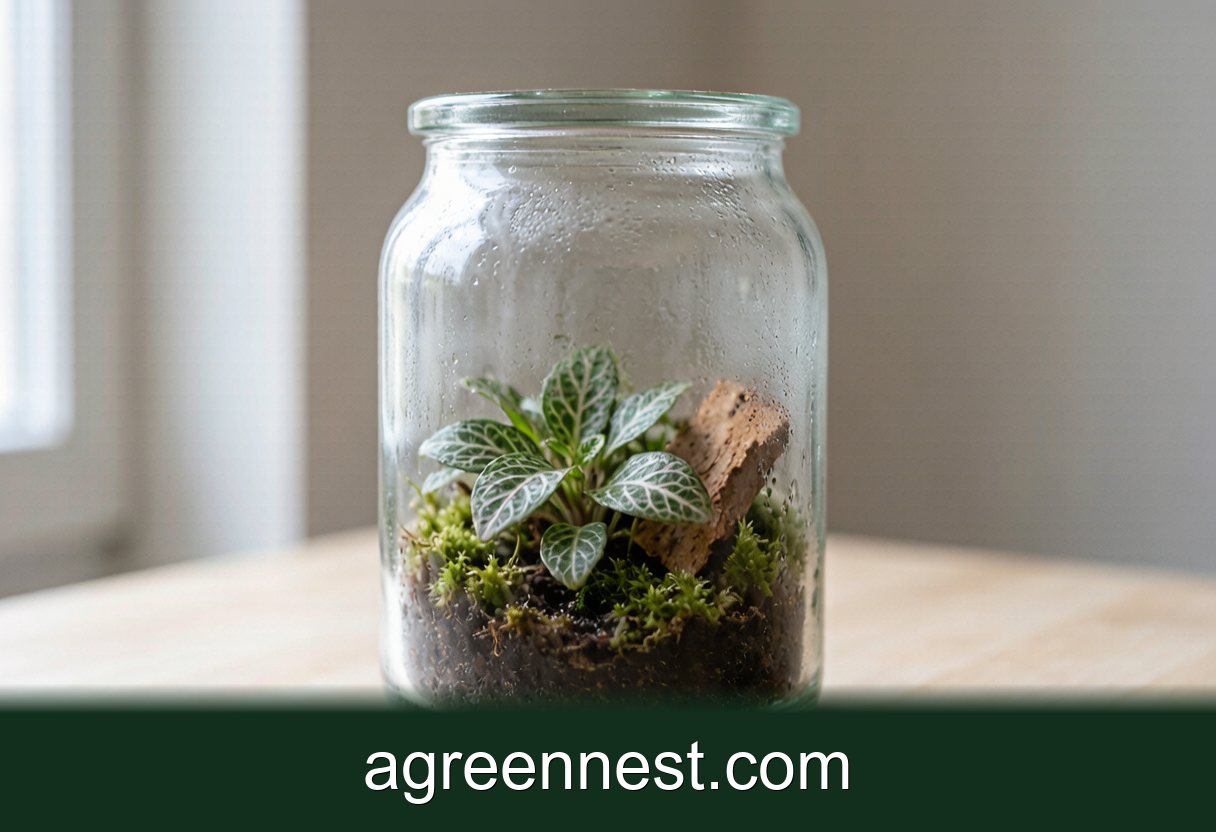
A closed terrarium should fog on the cool side for an hour or two after sunrise, then clear. Glass that stays opaque all day means too much water, too little airflow, or direct sun. Crack the lid for 30 minutes daily and remove roughly 10 to 20 ml of standing water at the base.
Three weeks after I sealed a 5 litre jar with Fittonia albivenis and a piece of cork bark, I could not see a single leaf. The glass had gone from morning mist to permanent white, and a grey bloom was creeping up the bark.
Nothing was dying yet. But a terrarium that fogs all day is telling you the water balance is wrong, and the fixes are cheap in week three, expensive in week ten.
Why Is My Terrarium Fogged Up All Day?
A closed terrarium runs at 90 to 100 percent relative humidity by design. Fog is not humidity, it is condensation, and condensation only forms where the glass is colder than the air inside it.
That gives you a diagnostic. Healthy behaviour: mist appears on the window-facing side within 20 to 40 minutes of the sun hitting it, covers half the glass, then clears by mid-morning as the jar warms through.
Permanent fog has three causes, in order of how often I find them:
- Too much water in the system. The mix was watered like a pot plant instead of a sealed loop. A 5 litre jar needs about 150 to 250 ml of water in total, not a soaking.
- Direct sun. Sun through glass pushes the interior to 35 °C or more, then it crashes overnight. Big temperature swings mean heavy condensation and cooked roots. Bright indirect light of roughly 800 to 1,500 lux for 10 hours is the target, which is what our terrarium lighting guide covers in detail.
- A cold surface. A jar 10 cm from a single-glazed window fogs on that face all day even when the water balance is fine. Move it 40 cm inboard and the fog often stops overnight.
The Two-Hour Rule for Reading Condensation
Rather than guess, run this check for one week and write down what you see at 09:00 and 15:00.
- Fog in the morning, clear by lunch: correct. Leave it alone.
- Fog all day, no droplets running down: slightly wet. Open the lid for 30 minutes each morning until the pattern shifts.
- Droplets running down the glass in visible streams: too wet. Open the lid for 2 hours a day for three days, and blot the base.
- No fog at all for a week, leaves crisping at the tips: too dry. Add 30 to 50 ml of water down the inside of the glass, not over the leaves.
Then check the drainage layer. Tip the jar 20 degrees: water should sit in the lower third of the leca and never rise into the substrate. If the waterline touches the soil, you have a bog, and bogs grow mould.
Why Is White Fuzz Growing on My Terrarium Wood?
Because you put a carbon source in a warm, wet, still box. That fuzz is almost always a saprophytic mould, often a Penicillium or Trichoderma species, feeding on the surface sugars of new wood, bark, or dried leaf litter.
On fresh hardwood and cork, a white bloom in the first 4 to 8 weeks is normal and self-limiting. It eats the easy sugars and dies back. I have watched it clear on its own in about 70 percent of the jars I have built.
Act when any of these are true:
- The fuzz is on living leaves or stems, not wood. That is closer to grey mould on houseplants, and it spreads.
- It is slimy rather than fluffy, or coloured black, orange, or pink.
- It keeps returning after month three.
The fix, in order: wipe the growth off with a cotton bud, give 2 hours of lid-off time daily for a week, raise the light a little, and add springtails. Folsomia candida is the standard cleanup crew, breeds in the leaf litter, and grazes mould faster than any spray. A tub of 200 populates a 5 litre jar in about six weeks, and the same logic applies to springtails in ordinary pots.
Do not reach for fungicide in a sealed container. You will kill the springtails and the beneficial fungi, and the mould returns with no competition.
What Makes a Terrarium Smell Like a Drain?
Sulphur. When the substrate sits waterlogged, oxygen runs out in the lower layers and anaerobic bacteria take over, producing hydrogen sulphide. That rotten-egg note is your signal that roots are next.
This is the one failure I treat as an emergency:
- Take the lid off and leave it off for 48 hours.
- Siphon standing water out of the drainage layer with 4 mm aquarium tubing. In a 5 litre jar I usually pull 60 to 150 ml.
- Lift any plant with blackened roots, trim to firm white tissue, and replant into fresh mix.
- If the smell persists after three days, strip it down. A rebuild costs an evening; waiting costs the plants.
The prevention is structural: a 2 to 3 cm leca drainage layer, a mesh divider, then 5 to 7 cm of substrate that holds air. I use 50 percent coco coir, 30 percent orchid bark, 20 percent worm castings, plus a tablespoon of horticultural charcoal. A peat-only mix collapses within months, which is why soil mould in normal pots so often traces back to a dense, airless mix.
Build Choices That Stop the Problem Before It Starts
Every fogged, mouldy jar I have rescued had at least one of these mistakes baked in at build time.
Species that suit a sealed box. Fittonia albivenis, Soleirolia soleirolii, Ficus pumila, Selaginella kraussiana, and Peperomia prostrata all want the wet air. Succulents belong in an open dish, which is why a succulent terrarium is built without a lid.
A mouth you can reach into. A 12 cm opening lets you weed, prune, and wipe glass. A narrow demijohn turns every maintenance job into surgery with chopsticks, a lesson most people learn on their first bottle terrarium.
Light that is steady rather than strong. A 9 W LED at 30 cm on a 10-hour timer gives repeatable conditions and no afternoon spike. Window light varies by a factor of ten between June and December.
Restraint with water at planting. Moisten the substrate until a squeezed handful holds together and releases one or two drops. You can add 30 ml later; removing it takes a siphon and a bad mood.
Frequently Asked Questions
Q: How long should a healthy closed terrarium stay fogged each morning?
A: Roughly 30 minutes to 2 hours, starting when light first hits the glass, and mostly on the coolest face. Anything past about three hours a day, every day, means the system is holding more water than it can cycle.
Q: Should I wipe the condensation off the inside of the glass?
A: Wipe it when you want to see in, but understand that it comes back within the hour if the balance is off. Wiping treats the view, not the cause. A cotton pad on a bamboo skewer works in narrow jars.
Q: My terrarium has been sealed for a year and never needed water. Is that normal?
A: Yes, if the seal is good. A well-built jar runs 12 to 24 months between top-ups. Check the drainage layer twice a year, and add 30 to 50 ml only when the leca has gone dry.
Q: Do I need to ventilate a terrarium in summer?
A: Watch the temperature rather than the calendar. Above about 28 °C inside the glass, open the lid for an hour in the afternoon and move the jar further from the window. Sustained heat plus saturated air is the combination that turns healthy fuzz into rot.
Fog is data. Morning mist that clears means the loop is working, permanent white glass means too much water or sun, and a drain smell means you have hours rather than weeks. Fix the water balance first, add springtails second, rebuild only when the base has gone anaerobic. If the jar sits in a dim corner, check the spot with our free light calculator before you blame the build.
Sources & further reading
GreenNest authors research and write every guide independently. The external links below are reputable references we recommend for deeper reading — they are not the sources we copied from.
- Michigan State University Extension — Gardening — Michigan State University
- NC State Extension Plant Toolbox — NC State Extension
- University of Minnesota Extension — Houseplant problems — U Minnesota Extension
Recommended Tools for DIY Plant Projects Care
Free, no-signup helpers matched to this guide.
🪴 Free Tool
Bottom Watering Guide
Get the exact water depth and soak time to bottom-water any pot without risking root rot.
Free Ebooks to Explore
Downloadable handbooks — no email required.
Free Ebook
The AGreenNest Succulent Care Handbook
The complete, beginner-to-confident guide to growing fat, happy succulents — 10 chapters and a 20-plant directory.
Free Ebook
Haworthia & Haworthiopsis Care Handbook
A focused guide to the striped, forgiving Haworthia clan.
Share Your Plant Story
Grown something tricky, or found a trick that finally worked? Tell us in the comments, or see what other readers are sharing on our Community page. The best reader tips get folded back into our guides.
Join the Conversation
Have a tip or a question about Why Your Terrarium Fogs Up (and When to Worry)? Share it below — comments are saved on our server.