 AGreenNest
DIY Plant Projects
Why DIY Concrete Planters Crack (And How to Fix It)
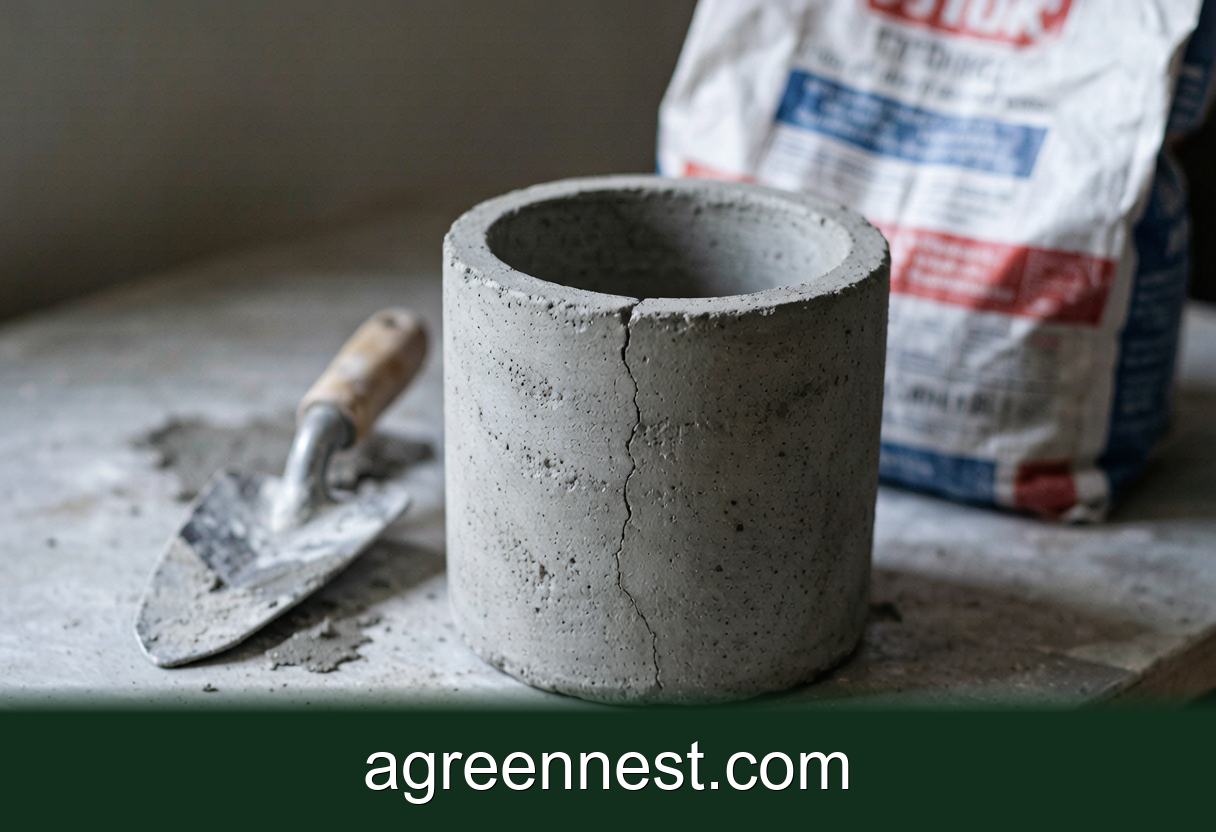
Concrete planters crack for three reasons: a mix wetter than a 0.45 water-to-cement ratio, walls thinner than 15 mm, and drying instead of curing. Keep the mix at damp-sand consistency, cast walls 18 to 20 mm thick, and hold the pot under plastic for seven days before planting.
Four of my first nine concrete pots cracked. Two split while still in the mould, one broke along the rim when I knocked it out at eighteen hours, and the fourth held together for six weeks, then opened a 2 mm line down one face on the first cold night of October.
None of those failures were bad luck. Each one had a specific cause, and after casting maybe sixty planters since, I can tell you which crack came from which mistake by looking at it. Here is the diagnostic, then the fixes.
Why Do Concrete Planters Crack While Curing?
Because the mix had too much water in it, and water is not an ingredient you get to be generous with.
Cement hydrates at a water-to-cement ratio of roughly 0.25 by weight. Anything above that is workability water, and it leaves the mix as vapour, so every drop of surplus becomes a void or a shrinkage stress. Aim for 0.40 to 0.45. In practice that means 400 to 450 g of water per kilogram of cement, weighed, not eyeballed.
The consistency you want looks wrong the first time. Damp sand. Squeeze a handful and it should hold its shape and leave your palm barely wet. If the mix pours like batter, you are already committed to a crack.
Two other curing-stage culprits:
Walls under 15 mm. A thin section dries from both faces at once and shrinks unevenly. I cast at 18 to 20 mm for pots up to 25 cm across, and 25 mm above that. Cut a stick to the gap width and check the mould at four points before you fill.
Demoulding too early. Sand-cement needs 36 to 48 hours before it can survive being knocked out. At 15 °C, give it the full 48. My rim break at eighteen hours was pure impatience.
The Cure Is Seven Days, Not Overnight
Concrete does not dry. It reacts, and that reaction needs water present for days.
Strip the mould at 48 hours, then wrap the pot in a plastic bag or sheet and leave it somewhere between 10 and 25 °C for seven days. Mist the surface once a day when you check it. Below 5 °C hydration stalls almost completely, so a garage cast in winter is a gamble.
Why Did My Planter Crack Weeks After It Was Finished?
Three suspects, and the crack pattern tells you which.
A horizontal split near the base, appearing after a cold snap. Freeze-thaw. Cast concrete absorbs 5 to 8 percent of its weight in water, and that water expands 9 percent when it freezes. Any pot living outdoors past November needs pot feet so it is not sitting in a puddle, and ideally it comes in below -3 °C. Standing water in the saucer is the actual killer, not the air temperature.
A vertical crack radiating from the drainage hole. The hole was too close to the wall or too small. Keep it 25 mm minimum from the side, and drill or cast at 20 to 25 mm diameter. Small holes clog, the pot stays saturated, and a saturated pot is a heavier, more brittle pot. The same clearance logic applies when drilling drainage holes in ceramic pots.
A bulge with a crack at the widest point. Root pressure. A Sansevieria trifasciata rhizome can genuinely split a thin-walled pot, and so can a mature Zamioculcas zamiifolia tuber cluster. If you plant vigorous rhizomatous species in concrete, go to 25 mm walls and check the root mass every second year.
The pH Problem Nobody Mentions
Fresh concrete leachate runs at pH 12 to 13. Most houseplants want 5.5 to 6.8. Put an Echeveria elegans straight into a two-day-old concrete pot and the roots meet something closer to oven cleaner than soil.
This is why people report a "cursed" homemade pot that kills everything while an identical one is fine. The fine one was older.
The fix is a leach. Fill the finished pot with water, leave it 24 hours, tip it out, repeat for 7 to 14 days. If you are impatient, a rinse of 1 part white vinegar to 5 parts water neutralises the surface, but follow it with two clear water flushes because acetate residue is its own problem. Test with a cheap aquarium pH strip on the runoff and plant when it reads under 8.5.
Sealing the interior with a water-based masonry sealer works too, and cuts the leaching to nothing. It also stops the wall breathing, which changes your watering rhythm: a sealed concrete pot behaves like plastic, not like clay. That difference is set out in terracotta versus plastic pots, and it matters more than the material name suggests.
Can You Repair a Cracked Concrete Planter?
Depends on the width.
Hairline cracks under 0.3 mm are cosmetic. Brush in a slurry of neat cement and water, wipe back, cure damp for three days.
Cracks of 0.3 to 1 mm can be opened out with the corner of a scraper into a shallow V, then filled with a sand-cement paste at the same ratio as the original. Expect a visible line.
Anything past 1 mm, or a crack that runs from rim to base, is structural. I stopped repairing those. A pot that splits under a wet 8 kg soil load on a shelf is a genuine hazard, and you can check that load in advance with the pot weight meter. Break it up and use the pieces as crocks or as the drainage layer in the next cast.
A Mix That Has Not Failed Me
By weight, for a pot around 22 cm: 1 part Portland cement, 3 parts sharp sand sieved through a 3 mm mesh, water at 0.42 of the cement weight, a pinch of polypropylene fibre.
Sieving matters more than people expect. Stones over 4 mm in a 20 mm wall create planes of weakness, and a homemade soil sifter handles it in a minute.
Method notes are in the full build walkthrough at making a concrete planter. This piece is the failure list that walkthrough assumes you will not need.
Frequently Asked Questions
Q: My pot cracked 24 hours after demoulding. Is it worth curing anyway?
A: Cure it and see. A crack that appears that early is usually shrinkage, and seven days under plastic sometimes stabilises it without widening. Measure the crack with a card edge on day one and day seven. If it has grown, recycle it.
Q: How long until a homemade concrete pot is safe for succulents?
A: Two to three weeks after casting, assuming you leached it with daily water changes for at least seven days. Succulents are less tolerant of high pH than most foliage plants, and root damage from alkaline runoff looks exactly like rot, so people misdiagnose it as overwatering.
Q: What is the white powder blooming on the outside of my planter?
A: Efflorescence, which is calcium hydroxide carried to the surface by evaporating water. It is harmless. Brush it off dry, or wash with a 1 to 10 vinegar solution. It usually stops after the second or third month once the free lime is spent.
Q: Can I use rapid-set repair concrete instead of Portland cement and sand?
A: You can, and the pots come out fine, but you get 8 to 12 minutes of working time and no chance to fix a badly filled mould. For a first planter use ordinary sand-cement, which gives you 45 minutes.
Almost every concrete planter failure traces back to a rushed hour somewhere: too much water in the bucket, an early demould, a plant dropped into a pot that was still chemically hot. Weigh the water, cast the walls at 18 mm, wrap it for a week, leach it for another. The pots I made that way are still holding soil four years on. If you want to size a pot to the plant before you build the mould, our pot size calculator will save you casting the wrong thing.
Sources & further reading
GreenNest authors research and write every guide independently. The external links below are reputable references we recommend for deeper reading — they are not the sources we copied from.
- Michigan State University Extension — Gardening — Michigan State University
- NC State Extension Plant Toolbox — NC State Extension
- University of Minnesota Extension — Soil and container basics — U Minnesota Extension
Recommended Tools for DIY Plant Projects Care
Free, no-signup helpers matched to this guide.
Free Ebooks to Explore
Downloadable handbooks — no email required.
Free Ebook
The AGreenNest Succulent Care Handbook
The complete, beginner-to-confident guide to growing fat, happy succulents — 10 chapters and a 20-plant directory.
Free Ebook
Haworthia & Haworthiopsis Care Handbook
A focused guide to the striped, forgiving Haworthia clan.
Share Your Plant Story
Grown something tricky, or found a trick that finally worked? Tell us in the comments, or see what other readers are sharing on our Community page. The best reader tips get folded back into our guides.
Join the Conversation
Have a tip or a question about Why DIY Concrete Planters Crack (And How to Fix It)? Share it below — comments are saved on our server.